Showing posts with label Colombia. Show all posts

Friday, May 02, 2008

The Faces of Colombia

When I was in Colombia, I took a lot of pictures of people. I always find pictures of people doing stuff or being themselves to be far more interesting than pictures of things, even if I have no idea who the people are.

I'm not a great photographer, but I tried to get a sense of the people I saw there. Some of the pictures below are people we met, but most are random Colombians. My camera has a studly zoom on it, so I was able to snap pictures from our mini-bus without most people feeling like I was stealing their souls.


Here are some kids at a park, who were actively campaigning to have their picture taken:

Cute Colombian girl:

Cute Colombian kids:

Our hostess Alba and our driver from church:

A boy working:

A scholarship family:


I assume a Dad and his disgruntled daughter:

The fearless girl to the right liked to ride her skateboard down a very steep hill. I was impressed with her bleeding hand, which you can just barely see. The boy with the skateboard wanted to impress me with a John Cena shirt he had on, but I had no idea who that was. I later learned he is a professional wrestler. Hurray for the export of American culture! Mostly, though, hurray for the enthusiasm of youth.

Some Colombians are fat and plastic and need rollers to move around:
A grizzled old man with a pink umbrella:

Another grizzled man. You might think he was scowling at me, but he wore that expression well before I took the picture:

A young grizzled man:


A young man lost in his thoughts:

A sweet young couple: A pensive young lady:
A woman selling flowers between cars:
Another couple:


An adorable little girl:
A future performance artist:
Time to go home:


Thursday, April 03, 2008

Colombia Word of Witness

The group of us that went to Colombia last month gave a short word of witness at First Mennonite last weekend. Here is the text for my remarks:

---------------------------------------------------------

Before I left for Colombia, Jan and Earl Kellong met with the junior high youth to talk about their own trip to Colombia about a year and a half ago. I’m sure they gave a balanced view of the country, talking about both the good and the bad there. But my daughter Chloe came out of that meeting apparently hearing only one thing: Colombia is a dangerous place where people get kidnapped.

So, she unilaterally decided that I was not going. When she was asked by others about by my upcoming trip, she very earnestly told them that I was not going, because she was going to lock me up in the bathroom so I would miss my flight.

I was touched that she was so concerned about her dear-old-dad, but I was already committed to going. So, in the end we reached a kind of truce. We agreed that even though I was still going to Colombia, in her presence I would agree to call “Colombia” “Florida”. “Chloe, when I’m in Florida, you will need to be extra helpful to mom. Dad, when you are in Florida, send us email” etc. This seemed to put her at ease.

To be honest, I was a little nervous about going as well. But even though there was a major border disputed while we were there, going to Colombia with our group wasn’t all that dangerous. North Americans still have privileges, even in a country where 10 people a day die as a result of armed conflict. In fact, I realized that one of those privileges is travel itself. Anyone here can go to Colombia, but it is extremely hard for Colombians to get visas to visit here.

Greg Springer recently wrote on his blog about “traveling with a purpose.” Too often, Americans view/use other cultures as a form of entertainment, or as an outlet for recreation. It would be better to recognize the privilege of travel and use it as an opportunity to grow, to connect with others, to more deeply understand the state of the world. Travel should cause us to learn something, not just about others, but also about ourselves.

Now. It is entirely appropriate for a 13 year old girl to want her dad to go to safe Florida instead of dangerous Colombia. But I think all too often, those of us with more resources and more stature in the world choose to do the same thing. If Dusty and Lefty, our Mennonite Cowboys, were around, they might say this is a metaphor (or a simile), for how we live our lives. Traveling with a purpose is just a subset of living life with a purpose. Especially as Christians, we should seek more than comfort. We should seek interaction and community with others, and to be of service to those in need. And we can only do that by stepping outside into the big wide world, where there is risk and possible danger.

In my own life, I don’t often live up to this. I literally go to Florida for most spring breaks. If I were to look at this in the most uncharitable way possible, I could describe it as taking a break from my life of privilege to relax in a different, more pleasant place of privilege. That’s not even a metaphor – it is what I do.

It may sound like I am about to go down the path of beating up myself and everyone like me about our comfortable, privileged lives, where the end result is to feel guilty, and then mope around for the rest of the week. But it turns out that feeling guilty, in an of itself, doesn’t actually help Colombians nearly as much as I would hope. That’s too bad because I’m pretty good at feeling guilty, and it doesn’t take a lot of effort.

But I also don’t want to suggest that we, as Americans, have the answers to all of Colombia’s problems. Man, if I just stopped going to Florida, everything would be fine in Colombia. They say it takes as long to get out of a war as into a war, and Colombia has been at it off and on for 60 years. We must do what we can, but we must recognize that it will be just one voice in a larger choir, the throwing of one fish back into the sea.

In the end, the important thing about trips like this is not necessarily the actions we take when we come home. It is the nourishing of our relationship with our sister church that probably has the biggest impact on daily lives. Having faces and voices and mental pictures, and walking with our brothers and sisters, even for just a few days, makes the relationship real and fosters a lifetime of advocacy for our friends. A two-way interaction is far more valuable than simply sending money.

Nonetheless, I come back from trips like this convinced that, given my relative position of power in the world, there are some concrete actions I should take. Luckily, MCC has been sponsoring trips like this for awhile, and they know how to help with the transition. At the end of April, they are sponsoring a Day of Prayer and Action for Colombia. They are asking North American and Colombia churches to join together to take some action for peace in Colombia. I’d like to share with you some of the ideas our group had as we processed what actions we could take for Colombia:

  • We can advocate to our government that the US reduce the amount of military aid it gives Colombia, and increases the amount of humanitarian aid.
  • We can choose to pay a little more for free trade Colombian coffee and dried fruit at Ten Thousand Villages, to provide livable wages to some specific Colombians.
  • We can advocate that the US stop fumigating farmland which destroys it for a generation, and introduces health problems to the local populace.
  • We can support the sister church program in Colombia by finding other like-minded churches here in town to start relationships with other churches in Colombia.
  • We can advocate against the Free trade agreement that is being debated in Congress, which will harm Colombian farmers, some of whom already turn to growing coca because of their destitution.
  • We could send someone to EDR to teach English for a year.
  • We can learn Spanish ourselves.
  • We can keep our relationship with our sister church going strong, by continuing to support learning tour missions.
  • And, finally, we can pray.
    • We can pray for the well being of our friends at EDR.
    • We can pray for strength and guidance.
    • And we can pray not just that God’s will be done, but that we will be faithful enough to be God’s hands where it is needed.

    Tuesday, March 25, 2008

    To Give or to Go

    My weekly column is up at Smile Politely, where I attempt to justify my trip to Colombia in purely economic terms.

    Wednesday, March 19, 2008

    Ignorance Is Bliss

    I have a new post up at Smile Politely today, where I explain how my experience in Colombia demonstrates that ignorance is bliss.

    Tuesday, March 18, 2008

    What Provokes You?

    There will be a continuing Colombia afterglow on this blog until I get back in town and start the regularity of normal life. Here's another quick story about culture and language.

    One of the members of our delegation was Pastor Samuel, a Guatemalan who is the pastor of an Hispanic church in Portland. During his stay with his sister church in Colombia, he happened to be alone with the pastor's wife at their house, and she asked him in Spanish "So, what provokes you?"

    What a great question, I thought. I should ask more people that - it is very open-ended and filled with possibilities. However, in Guatemala, the wording of it in Spanish could also be interpreted as "So, what turns you on?"

    Hmmm, thought Pastor Samuel, I'm not quite sure what she means by this. In fact, this could become downright uncomfortable. After an uneasy silence, she offered some options: "Chocolate, juice, water" other beverage options. Ah, he thought, here it just means "would you like anything?" He gratefully accepted a beverage.

    Apparently, miscommunication and cultural differences are not limited to gringos in South America. For that I am grateful.

    Friday, March 14, 2008

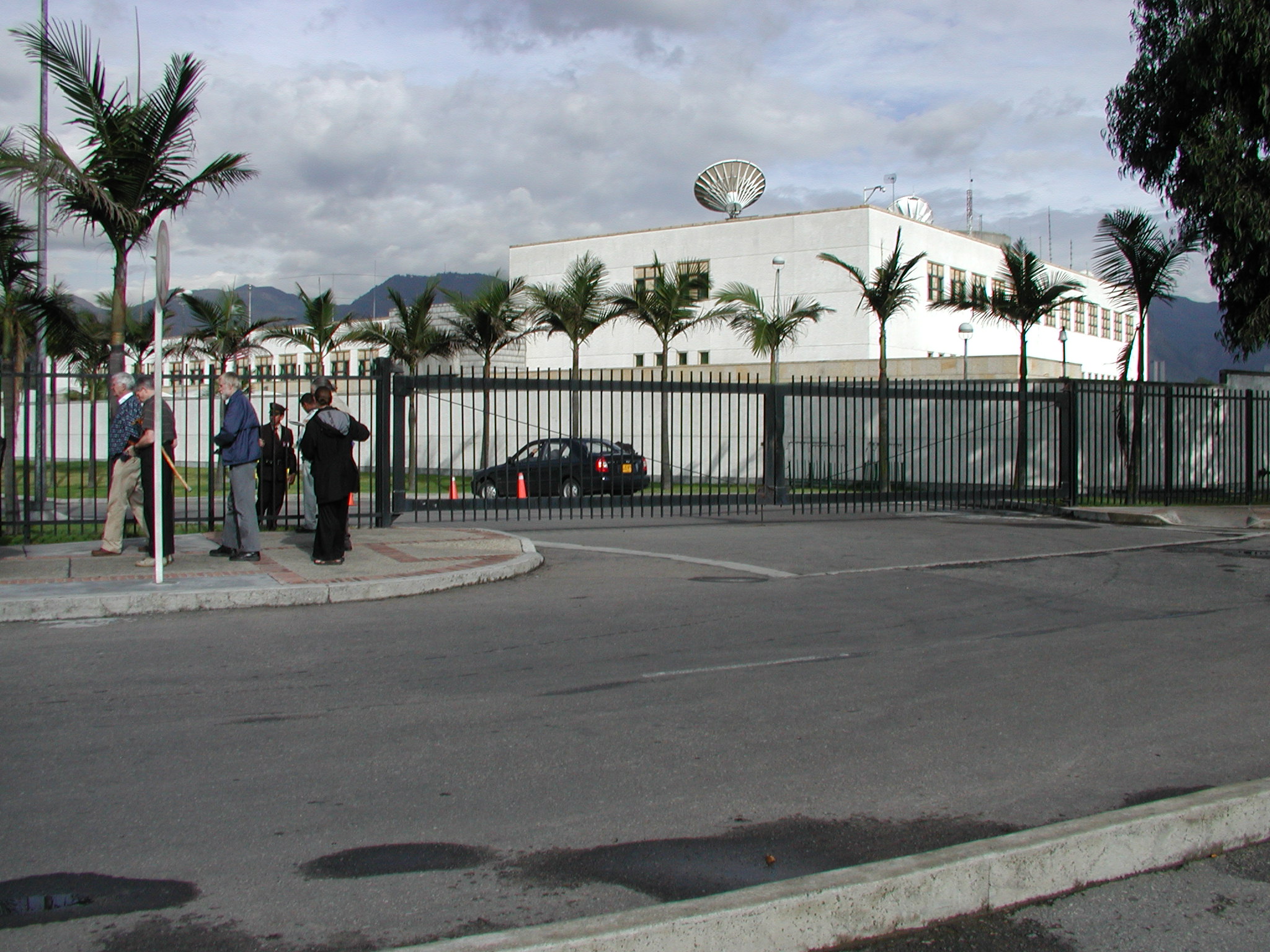
    US Embassy Visit

    Despite the frequent teasing Wilmer earned for being on the phone so much while we were in Colombia, he redeemed himself by speaking truth to power at the US embassy on the last day of the trip. We spoke with someone from the department that handles human rights and labor issues.

    The US Embassy here is the 2nd largest in the world, behind Iraq, with about four thousand people. Colombia receives the 3rd largest amount of foreign aid from the US, behind Israel and Egypt. One thing I learned is that the “mission” (the embassy) determines many of the particulars of how the money is spent, so even though they are given specific policies to adhere to, they have some power in how Plan Colombia actually plays out in Colombia.

    We came with 4 or 5 topics of discussion, including visas for church delegations from Colombia, the free-trade agreement, drug policy, and human rights abuses by paramilitary. Wilmer managed to get a word in most of the discussions, with his basic messages being:

    • Our drug policy doesn’t work – cocaine prices are the same as they’ve been the last few decades.
    • The economy may go up as a whole, but that doesn’t seem to make a dent in poverty.
    • Fumigation is stupid and dangerous.
    • The free trade agreement will be a disaster for poor Colombians.
    I’m exaggerating for effect here. Wilmer is, after all, a salesman who knows how to say such things in ways that forestall armed guards from coming in to haul him away. Still, I appreciated his stances and his advocacy.

    I asked about whether the US agrees with the Colombian government when they claim there are no paramilitary left in the country, which is blatantly false. She gave a very clever answer: There are no paramilitary, because they’ve redefined what paramilitary means. They only count as paramilitary if they are “not political”, which apparently means actively trying to overthrow the state government. This, of course, has never been the intent of the paramilitary.

    Nonetheless, paramilitary do control certain regions, grow cocaine, and sell it to finance themselves. The last time I checked, controlling some area of geography involves governing of some kind, which makes it political. The answer is about as useful as saying we don't torture people because our definition of torture is "things we don't do."

    So, the problem remains that the Colombian government is only interested combating guerillas, and sweeps the paramilitary problem under the rug by claiming it does not exist. This apparently has the blessing of the current administration.

    Nonetheless, it is important to remember that the embassy folks are just people doing their jobs. They want a peaceful Colombia as much as anyone - it is just that I totally disagree with the policies they must follow to try to accomplish it. They did offer to help if there are any human rights abuses that happen to the sister churches we have relationships with, and I believe they are sincere in that.

    Thursday, March 13, 2008

    Back Home

    We've arrived home safely, without too many hassles. Wilmer and I had to take a taxi from O'Hare to Hyde Park to pick up a car that stalls at stoplights to be the final leg of our journey, but we got home before midnight. Wilmer claims that all his travels are this adventurous, and I don't need much convincing to believe him. However, he and I had a great chat on the way down, and reconsidered whether we shouldn't have been doing more of it during the rest of the trip. Poor Ken had to watch me and Wilmer type most nights, since we often got back to the hotel so late.

    I am already feeling the oncrush of domestic responsibilities, as we are leave tomorrow for a week-long visit to Jill's brother's during spring break. I hope to post some more Colombia stories, but they may be slow in coming.

    Thanks to everyone for your thoughts and prayers and web responses during our time there. It was comforting to know everyone was with us in spirit.

    Tuesday, March 11, 2008

    Random Images of Colombia

    If pictures are worth a thousand words, consider this a 25,000 word essay. I have lots of other posts I plan to do about Colombia, but before I actually leave the country, I want to post a few random images.

    Here's me, on top of Monserate, which overlooks Bogota:

    Here's Wilmer on the phone in front of the Bogota Mennonite Church:
    Here's Ken holding a baby:

    This is JustaPaz, where we spent of lot of time:

    This is near Bucaramanga, where one of El Divino Redentor's missions is:


    Here's some Colombian boys enjoying a swim:
    Here's Wilmer on the phone:

    This is for Jill, who likes to take pictures of flowers:
    This the truck that First Mennonite helped pay to deliver food:
    Here's Wilmer hiding behind the truck, having figured out that we are taking pictures of him on the phone:
    Here's LuentroLeandro and Andreas Daniel (Andres' brother). Leandro is the son of Pastor Israel, and both are friends of "Pastor Greg":


    Here's Ken holding another, especially happy, baby:

    Here's Wilmer on the phone:
    Here's our lovely host family, in order: Julianna, Alba, and Valeria
    Here's Ken and I with the host family:
    Here's Wilmer hiding again while on the phone:

    Another Jill picture:
    A bridge amidst natural beauty:
    Wilmer on the phone:


    Our host family's apartment:

    A neighborhood in Bucaramanga:


    We are all getting tired:


    When Wilmer was tired of talking, he would email:

    Me, tirelessly working to bring news of Colombia to the world:
    Our partners in crime:


    I apologize for not including all the pictures I have of Wilmer on the phone. I don't want to slight him, but I'm guessing blogspot has a limit for the number of pictures you can upload.
    As much fun as we had giving Wilmer a hard time, I must say that he did a great job grilling the US Embassy worker today. I'll post that story later.
    We fly out early tomorrow. I'm looking forward to seeing my family, and drinking tap water.

    JustaPaz Documentation Project

    The Colombian government has two kinds of competitors to organized violence in the country: insurgents and paramilitary. Unfortunately, the government is only inherently motivated to fight one of them: the insurgents. Their solution to insurgents is to try to kill them and their solution to the paramilitary is to claim they do not exist.

    The logic of a paramilitary force is to eliminate the support of an irregular army (like guerillas) that can’t be defeated by a regular army. This is true everywhere in the world – paramilitary doesn’t exist to fight the state, but to fight insurgent groups. Paramilitary may not be directly controlled by the state, but their intent is to eliminate threats to those with economic power (such as plantation owners or drug lords). If the state is not strong enough to eliminate those threats, those wiith money and power will buy or acquire a paramilitary force that will.

    They then engage in a variety of atrocities, like going into villages and areas where there is a guerilla presence and massacring everyone there. If the state were to do this, they would get blamed for human rights violations. But they can claim they have nothing to do with it if they allow paramilitary to do whatever they want.

    In addition to fighting insurgents, the paramilitary in Colombia in the 80s and 90s destroyed almost all legitimate opposition groups. For example, they assassinated over 3,000 members of a legal opposition political party, plus scores of union leaders, peace activists, etc. In the end, the only opposition left was the insurgents, so there is now the assumption that whoever is against the government must be a terrorist. Gee, that sounds kind of familiar.

    Another twist in Colombia is that drug money took over the country. Both paramilitary and insurgents started growing coca to finance their own operations, and the government benefits from massive military aid to fight drugs (or terrorism, depending on the political climate in the US). With an unending supply of money flowing in, the violence was and is able to continue indefinitely, because everyone can afford to continue buying more weapons to fight each other.

    However, the insurgents have lost most of their popular support by acting more and more like paramilitary over the years. This has made it a little easier on the government. The military aid and political support they get from the US (“Plan Colombia”) is supposed to fight insurgents and dismantle the paramilitary. They certainly get the “fight insurgents” part. They are so aggressive in going after insurgents that President Uribe has fired dozens of generals because they were not able to kill them fast enough. This has lead to the military attempting to pump up the numbers by killing civilians and dressing them up as insurgents in order to get their numbers up.

    On the paramilitary side, they have made some strides, by getting a lot of the paramilitary to disband. However, the disbanded groups have often just formed different groups, and gone on as before. And yet, the official government line is that paramilitary no longer exist, and that the killings are mostly happening by and to insurgents, or are random acts of violence.

    The first step in counteracting official government misinformation is to collect real data and make sure it people have access to it. JustaPaz is one of the organizations in Colombia doing the unpleasant work of collecting stories and counting victims. It has released two volumes of its report “A Prophetic Call” that documents human rights violations that happen within the context of Protestant churches. There are also plenty of Catholics and people not associated with a church who are victims, but JustaPaz has very limited resources, and the Jesuits and others collect info on other populations.

    JustaPaz investigates each violation, and talks to the victims. It tries to do so in an anonymous way, but last year, its offices were broken into, and its database was stolen. The government is classifying it as an economic crime of a few stolen computers, and isn’t doing much to investigate, despite the problem that victims who come forward often do so at considerable risk to themselves. Stealing data that can identify them is at least an act of intimidation, and possibly much worse. Other peace and justice organizations have also had their computers stolen around the same time, so obviously the documentation process is getting some unhappy attention by those in power.

    They say it takes as long to get out of a war as to get into one. Colombia’s has been going on at various levels of intensity for 60 years, so recovery is going to be a long process. However, despite the continued violence, it is good to know there are committed people watching and counting, and it is good for them to know that people support them in their work.

    Monday, March 10, 2008

    El Divino Redentor

    We had un rico time in Bucaramanga, where “Pastor Gregory” Springer is beloved by all. I’ll post later about all the programs that El Divino Redentor is doing, but for now, I want to post some pictures about their worship services.

    Here’s the front of the church:


    The building is both the church and the residence for Pastor Israel and his family. This is a problem with the government, because they have a newish policy that requires churches to be in “real” buildings, with parking lots, and approval from neighbors. We are told it is a way to discourage Protestants churches and support Catholic Churches, which are 90% of the churches in Colombia. Pastor Israel is trying to raise funds so they can be in compliance, but it will cost hundreds of thousands of dollars to do so, and will take away from their service programs.

    Here is the inside:


    And here is the alter area (what is that area of a church called, anyway?)


    The church day starts at 9:30am with Sunday School, which is more like a Bible study for everyone. It is actually a lot like SS at First Mennonite, with some poor, harassed teacher trying to get a point across while lots of people point out objections and complications. The message this Sunday was a passage from Matthew about being a servant like Jesus and feeding the poor. A concern for service is another way we are similar.

    However, even though the content is familiar, the form of the worship service is very different. EDR is a Lutheran church, and it is very much what I grew up with as a Catholic. The sermon was delivered by Maria Elena, who visited FMC a few years ago, so it was nice to see a familiar face. She is the pastor at one of EDR’s “daughter” churches that is now completely self-sufficient.


    They had us introduce ourselves during the service, and when we mentioned that FMC was singing Psalm 130 in Spanish in their honor this morning, they asked us to sing it for them. Unfortunately, we had no idea what it was. So they asked us to sing something else, since it is well known how lovely Mennonites can sing. They didn't get the memo that Wilmer and I are terrible singers, and Ken is not good enough to save us. We decided on the doxology, because it is simple, and we all knew the words. Or, at least we thought we did. We started out with confusion over gender (“Praise Him all creatures here below” vs “Praise God all creatures here below”), and then we started singing different lyrics entirely. I thought perhaps there was some other verse that I didn’t know about it. I think mostly we cracked under pressure.

    The good news is that EDR may not have noticed, given that we were singing in English, and that, while they have many gifts, congregational singing is not among them. Earlier they were singing a hymn where the bass line is supposed to echo the melody, and Ken was singing it, correctly as far as I could tell. Our hostess got this horrified look on her face, and pointing out to Ken the melody that he was supposed to be singing, thinking he was hopelessly lost and off-beat.
    Afterward, they had on the schedule “Tinto & Diologs” which means “Coffee and Conversation,” another thing that made us feel right at home. The also gave a very sweet presentation about Colombia, the message being that Colombia is not just drugs and violence – it is natural beauty and welcoming people, of which EDR has been such a gracious example of. I got a copy of it for our Vacation Bible School this summer.


    Here's the Martinez family: (Loraci, Daniell, Paster Israel, and Leandro):
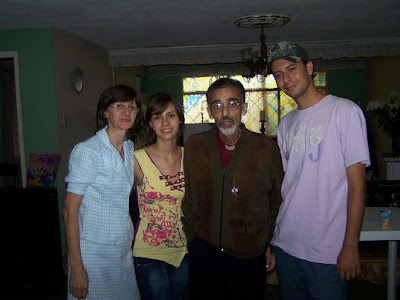


    The bad news is that Pastor Israel developed a fever Sunday evening, and went to the hospital, because they are not taking any chances, given that he is recovering from cancer treatment. Keep him in your thoughts are prayers.

    Oh, I almost forgot: We presented the JYF photo album, and it was very warmly received. Here's one of the families that provided Gordon and the Kellogs hospitality during their visit (I didn't get their names), and the girls were happy to see the photos:

    Finally, here's Ken with his new friend Valeria: